Never underestimate the power of nutrition!
A thorough understanding of nutrition contributes to the development of strong, resilient animals that can withstand stress and thrive. An effective nutritional strategy goes beyond quantity—it also requires the right quality and nutritional composition. Currently, there is no “silver bullet ingredient” that instantly solves all these challenges.
Robust and resilient animals are characterized by a healthy gut. Tail biting is strongly linked to inadequate nutrition and poor gut health. Research over the past decade has revealed a complex interplay between gut microbiota, gut health, and the brain, which influences mood and behaviour through the so-called microbiota-gut-brain axis. Our experience shows that farms experiencing gut problems after weaning have a higher risk of tail biting, both in the nursery and during the fattening phase.
But tackling this bitter problem doesn't begin in the nursery. It starts already in the sow farm. Sow nutrition and management have a clear impact on piglet quality and the ease of the weaning process itself, which in turn affects biting behaviour.
-
Start with the sows:
The sow's immunity and microbiome directly influence piglets' immunity and microbiome. Immunity transfer depends on the quality and quantity of colostrum, which can be improved through nutrition and targeted ingredients such as medium-chain fatty acids. Piglets, on the other hand, are inoculated with the sow's microbiome at birth. An unhealthy microbiome puts piglets at a significant disadvantage from the start. Harmful bacteria can gain the upper hand, leading to diarrhoea and intestinal damage. This is a situation we want to avoid. Sow nutrition has a clear influence on the microbial composition in the sows' intestines and, consequently, on the microflora of newborn piglets.
-
Encourage early feed intake:
To develop a healthy gut, newborn piglets must be trained to eat solid feed right from the start. This ensures that they develop a healthy gut suitable for digesting solid feed and that the weaning process proceeds smoothly.
-
Focus during the weaning process:
Tail biting is often the result of discomfort. There is a clear link between post-weaning diarrhoea and biting behaviour. The first week after weaning is crucial. During this period, piglets should be in optimal, comfortable conditions, with sufficient water, high-quality feed at all times, and adequate space.
-
Create comfort for piglets and their guts
Piglet well-being is closely linked to gut comfort. Therefore, the nutritional focus should be on stimulating feed intake, preventing overeating, ensuring good digestion, and thus creating a healthy gut environment.
The main risk factors related to nutrition are:
- Over- or undersupply of protein
- Imbalance in amino acids such as tryptophan
- Low fibre content
- Feed particles that are too small.
All these factors can disrupt the microbiota-gut-brain axis, which can lead to dysbiosis, gastric ulcers, anxiety, stress, and consequently, an increase in biting behaviour.
A satiated pig is less likely to bite. Satiety is influenced by the fibre content and the physical structure of the diet. Both also have a significant impact on stomach function and thus on the digestion of feed and in particular proteins. Modern pigs with high growth potential require higher levels of amino acids. Deficiencies can lead to aggressive or abnormal behaviour, including tail biting.
Pigs should preferably be fed ad libitum. Feed restriction often leads to nervousness and “slug-eating”, meaning they quickly consume large amounts of feed, often after a period of hunger or feed restriction. This can cause digestive problems and increase the risk of tail biting.
A healthy gut microbiome not only improves digestion but also the immune response. Studies have shown that pigs with a well-developed microbiome cope better with PRRS and PCV infections, resulting in better growth, lower mortality, and less stress. All of this helps prevent tail biting.
-
Protect against risks of mycotoxins and endotoxins
Certain mycotoxins, such as DON and ergot alkaloids, can lead to tail necrosis, which often precedes tail biting. Endotoxins in the bloodstream can also damage microcirculation in the tail and ears, making these areas more prone to necrosis and biting. Enrichment materials like straw may also carry high mycotoxin loads and should be monitored carefully. Using a broad-spectrum mycotoxin and endotoxin binder is an effective strategy to help reduce these risks.
-
Take care of water, the most important feed nutrient
For many, this goes without saying, but it's often overlooked. The type of drinking system, water pressure, temperature, quantity, and quality also deserve necessary attention.
Proven approach in Finland, a country experienced in farming pigs with long tails
Royal Agrifirm Group began working with undocked pigs in Finland in 2017. Through intensive collaboration with the farmer and his farm management, genetics, and slaughterhouse consultants, extensive knowledge was developed on how to successfully breed pigs with long tails.
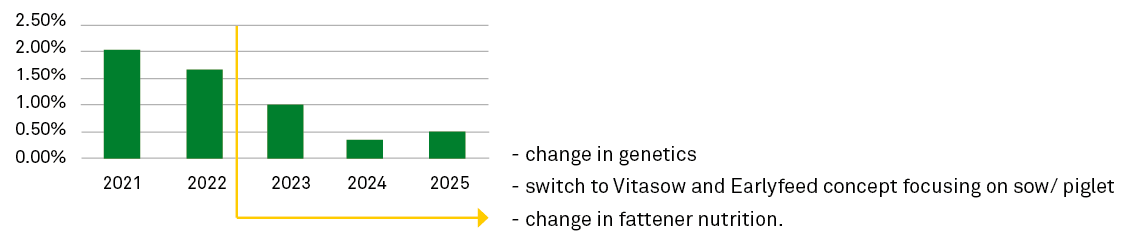
A key learning point during our customer journey was the optimization of the fiber content, physical structure, and the amino acid pattern of the feed. Higher amino acid levels resulted in fewer incidences of biting. The high-performing animals required special attention to climate control. This multifactorial approach can reduce the risk of injuries in pigs with long tails to 0.5%.